

By Howard Tsumura
Varsity Letters
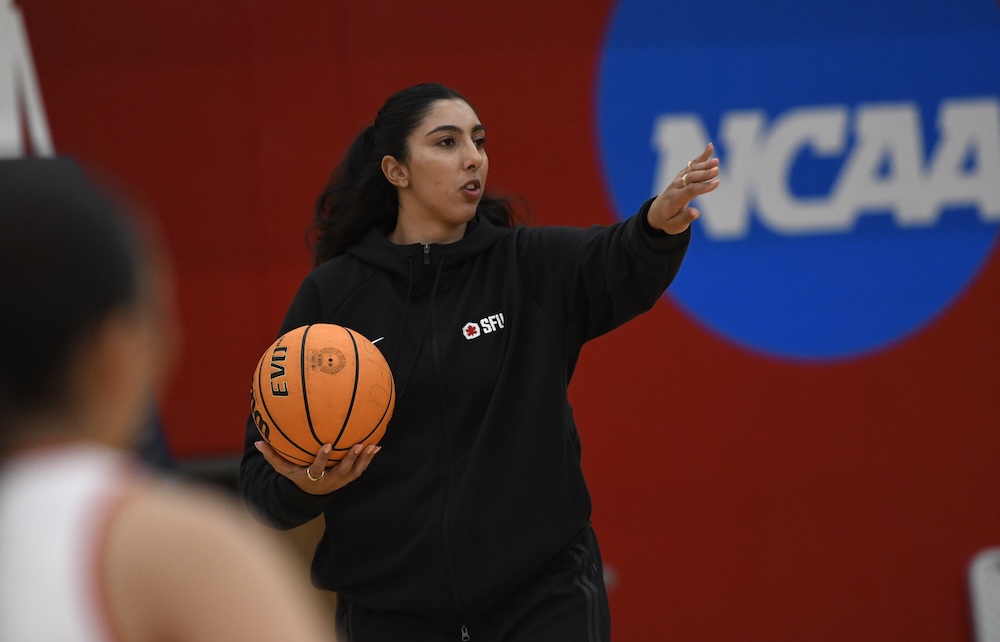
BURNABY MOUNTAIN — All summer long, enveloped not only by the sheer history of her new surroundings but as well her innate appreciation of it all, new Simon Fraser women’s basketball head coach Shae Dheensaw found herself making fast friends with the feelings of affirmation that come from full-circle moments well-earned.
They manifest themselves unannounced like a gentle nudge too profound to ignore, and they’ve just kept on coming, kind of like they did the day before a recent interview with Varsity Letters.
On that occasion, while getting some work done on her computer, Dheensaw’s screen was suddenly a portal to the story of the very person responsible for pointing SFU women’s basketball — some 38 years ago — on the path to the modern-day identity it has worn with pride every day since.
“I don’t even know how I stumbled on it, but it was awesome,” Dheensaw explained of discovering one of the videos from Simon Fraser University athletics’ 50th anniversary celebration series back in 2015 in which former women’s head coach Allison McNeill was being asked to reflect on what made her debut 1988-89 team on the hill so special. “I literally just watched it yesterday.”
The video, told through the eyes of SFU’s eventual Canadian national team and Olympic Games head coach McNeill, as well as then-players like Michelle Hendry, Andrea Schnider and Heidi Hanson, has done nothing but gain gravitas in the decade-plus since its release, serving as a masterclass in conveying that which remains deliciously inscrutable: The magical feeling that can envelop a team when chemistry and a common goal take precedence over everything else.
And for Dheensaw, 32, who left the OUA’s Brock Badgers after two successful seasons as its head coach to venture back west to her home province and a new coaching perch atop Burnaby Mountain as the successor to the retiring Bruce Langford, McNeill’s words had the impact of an elder sage.
The part which touched Dheensaw the deepest?
When asked what made her debut 1988-89 team, the one whose aura created the blue-print and set the bar of success for everything that was to follow for the next four decades, McNeill replied: “The biggest thing with that first group… they were so good they pushed me to be better. I just went ‘Holy Cow, they are so good I just have to help them to be better.’ I think we pushed each other, but they challenged me every single day.”
For the team’s new coach to cherish those words… words delivered so powerfully and humbly in reflection by McNeill of a pioneering SFU team that broke bread in 1988, some six years before Dheensaw was born, is to define ‘legacy’ without ever needing to say the word.
“I resonated with her so heavily because I know I am built for this job,” relates Dheensaw, who after concluding her Div. 1 college playing career at Washington State embarked on what has been a self-starter’s 10-year wisdom-seeking quest for knowledge from some of the best coaches in the business.
“I also know I don’t want to be what I am now in two year’s time,” she adds. “I want to grow with these athletes. I want us to have such greatness that we are able to pull out of them to where I constantly have to show up better. That’s kind of what Allison was referencing and I think it’s a beautiful situation that I get to do that at SFU.”
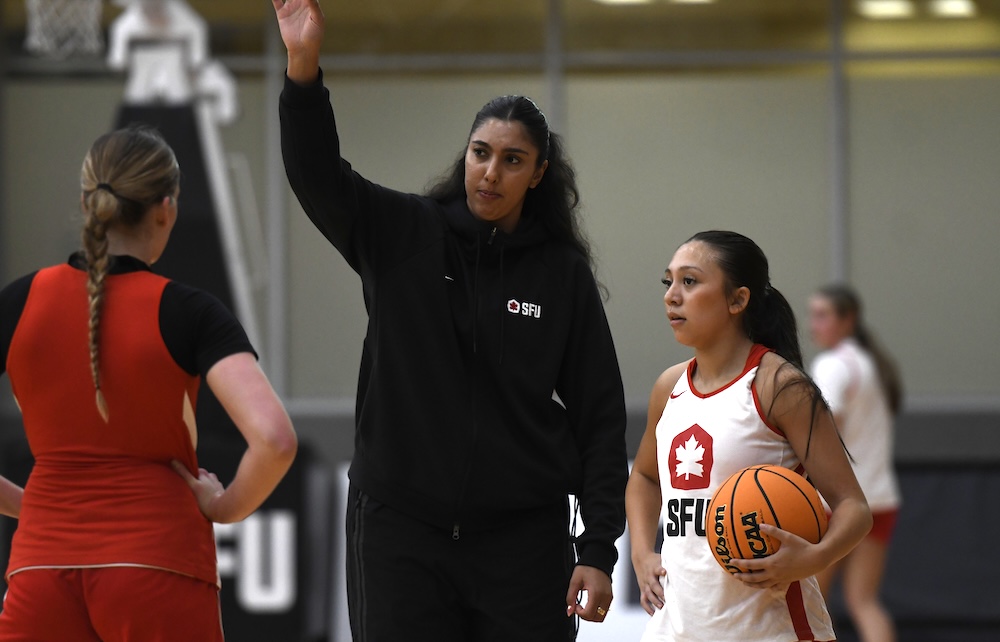
FROM HEAD OF THE CLASS TO TOP OF THE MOUNTAIN
During a past life as a sportswriter at The Province newspaper, your author had the chance to witness what to this day represents the golden age of girls high school and women’s university basketball in our province.
In an era stretching from 1997-2012, three different Canada West programs from B.C. combined to win 11 Bronze Baby national titles, while also finishing second on two occasions.
That’s 13 out 15 years with a B.C. school in the U SPORTS national final. To put things into perspective, a B.C. team has not appeared in the national final in the 14 seasons since UBC lost to Windsor in the 2012 national championship game.
Simon Fraser won in all five of its national championship game appearances (2002, 2005, 2007, 2009, 2010).
Victoria and UBC each won three national titles and were runners-up once each.
The Vikes won in 1998, 2000, 2003 and finished second in 1999, while UBC won in 2004, 2006, 2008 and finished second in 2012.
And it was during that so-called golden era that so many of B.C.’s best senior girls players became empowered by a sense of possibility, like no generation before them, as to where the game could take them… both in Canada and the U.S.
As a 6-foot-2 post with Victoria’s Claremont Spartans in her senior season of 2010-11, Dheensaw, herself a first-team provincial all-star fresh off the heartbreak of a top-tiered B.C. Triple-A championship game loss to W.J. Mouat, was just the kind of student-athlete ready to embrace all of the opportunities that just such a journey was sure to reveal.
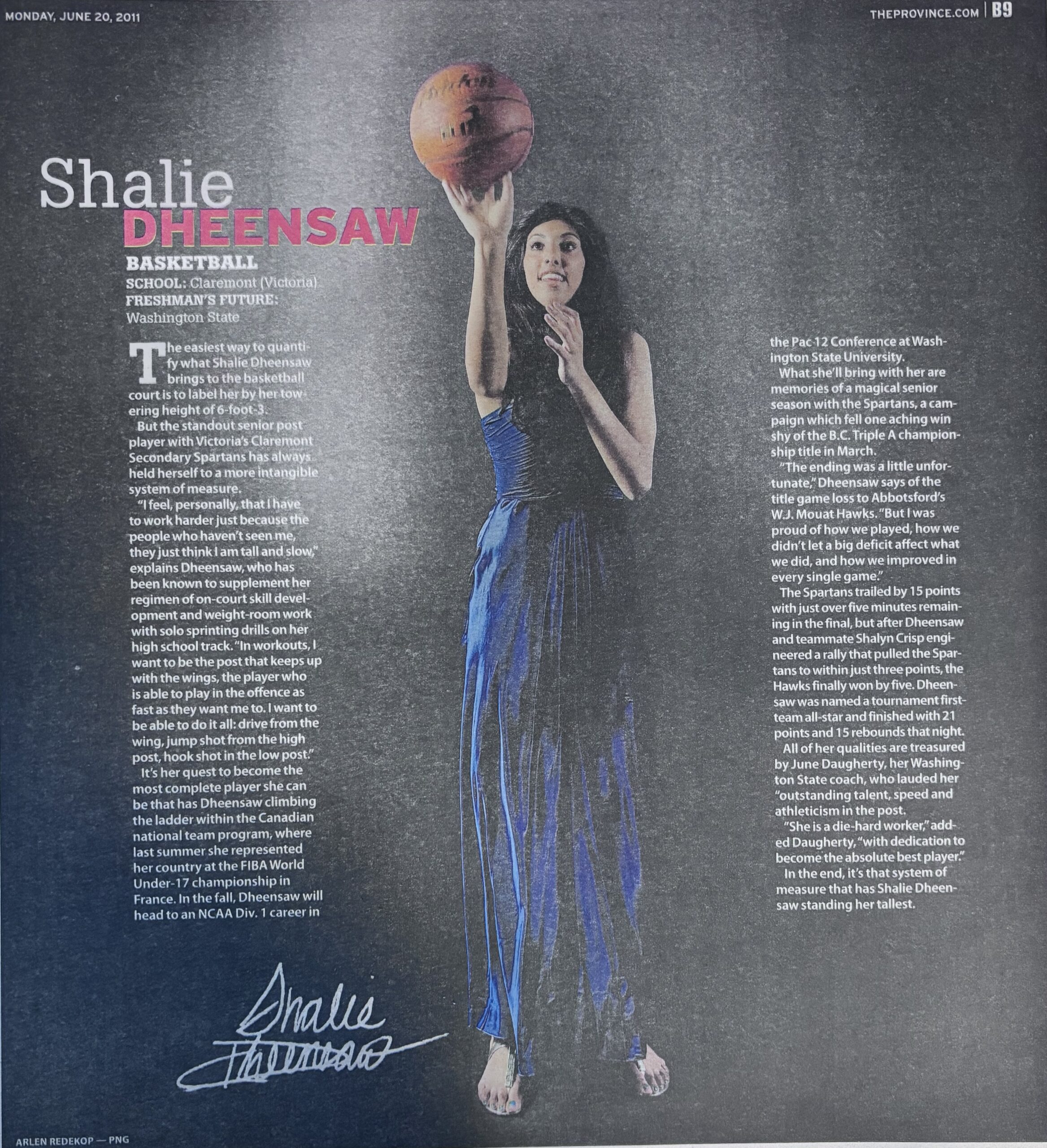
“When you look back at U SPORTS landscape, CIS at the time, B.C. was just ruling things when I was graduating,” remembers Dheensaw, who along with Abbotsford-W.J. Mouat’s Kayli Sartori were picked as B.C.’s top two graduating seniors in 2011 by The Province and featured in its annual Head of the Class special section (Shalie’s page above). “But the biggest thing for me was, I wanted to move away from home and experience something different. I knew I wanted to go and be a part of something that I could help build. I also didn’t want to walk into a position where they’re saying ‘OK, you’re going to start.’ I like to be a part of building and I want to have to work.”
All of that led Dheensaw to Washington State University where she apprenticed off the bench over the first 62 games which encompassed her freshman and sophomore seasons, then started the final 50 straight over her junior season and injury-shortened senior season, concluding her career in Pullman as the fifth-leading shot-blocker in program history.
Dheensaw experienced it all, highlighted by a 2013-14 junior season where she started all 34 of her team’s games and put her best performances forward in the annual home-and-away conference clash with the arch-rival Washington Huskies.
Yet before you can even get there, Dheensaw somehow finds a way to steer the conversation to those influential and inspiring individuals she met as a teenager and whose credos may not normally have carried the same kind of meaning to the younger student-athlete.
“I actually very much mimic what I learned from our athletic director — Bill Moos — at Washington State,” she says of one of the Pac 12’s historically-significant administrators who before returning for a second stint in Pullman in 2010 where he oversaw the Pac 12’s 12-year, $3 billion TV agreement with Fox Sports and ESPN, had kick-started the transformation of the University of Oregon’s athletic program over his 12 years as the Ducks’ AD, helping assure its stature today as one of the leading institutions in all of NCAA athletics.
“From him, I learned that you honour the past, live the present and build for the future… and that’s what our program here has set out to do,” she explains.
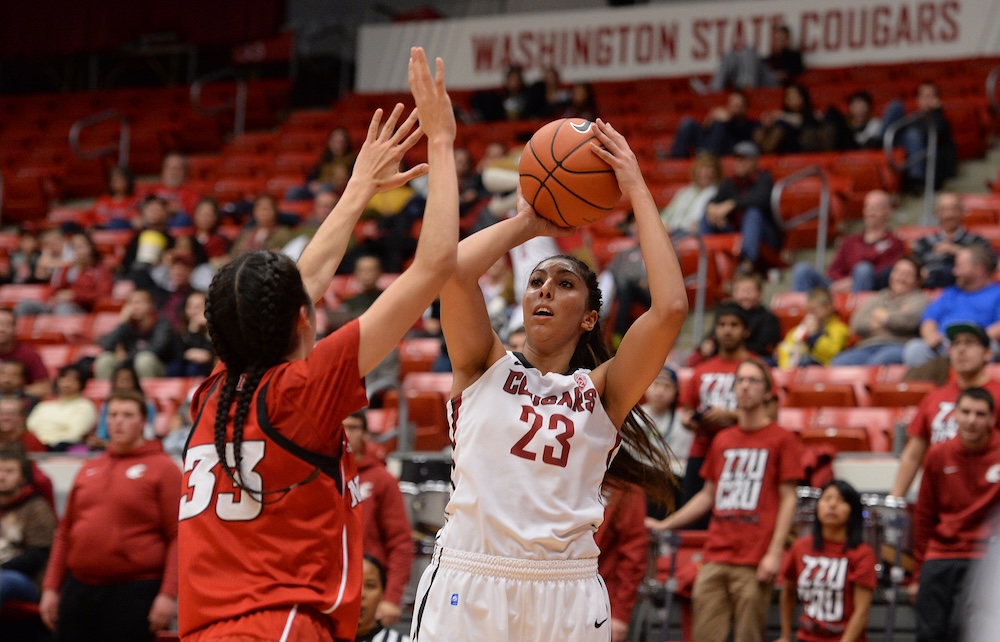
Dheensaw is resolute that what she experienced during her college playing days now serves as foundational bedrock in what she brings to her new position as Red Leafs’ head coach.
“Washington State was a medium-sized school with a really big heart and those are some of the incredible elements I carry with me coming to SFU which is a bigger campus,” she says. “But we don’t have to lose our big hearts in it. We can still be people-centred, still be people-focussed. You know, I’ve been an assistant coach longer than I’ve been a head coach, but I don’t have to lose what I love most which is the connections with the athletes. I think Washington State taught me that from day one.”
And so since her university graduation in 2015, she has been on a journey.
First as a graduate assistant in 2016-17 at the University of Washington, assisting a Huskies team in which star senior Kelsey Plum and Co. advanced all the way to the NCAA Sweet 16, then later back in the provincial capital (2018-21) where she served as assistant coach of the Victoria Vikes under head coach Dani Sinclair, then later interim head coach during the Covid-cancelled 2020-21 campaign.
Her time back in Victoria, within a Vikes program whose own spectacular success was built on the vision of the legendary Kathy Shields, proved formative in all the ways that it reinforced her own family lineage in a city whose championship basketball lineage challenges any in North America.
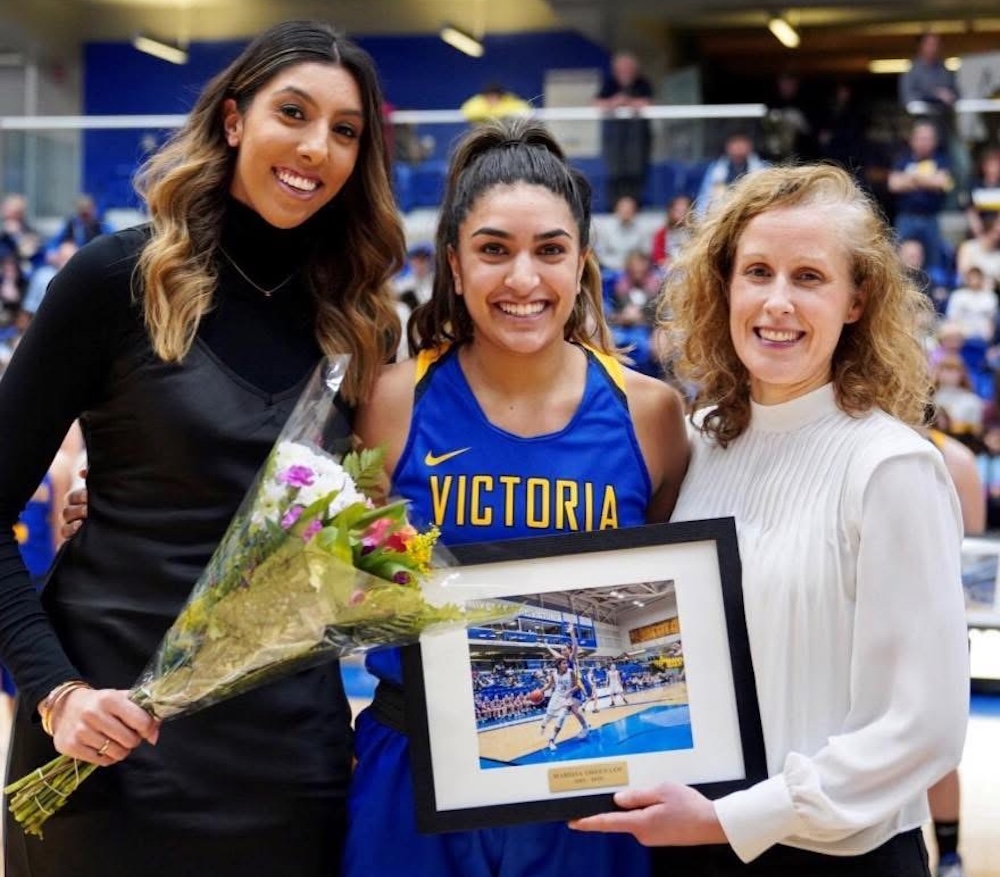
During her time as an assistant coach with her hometown Victoria Vikes under head coach Dani Sinclair, Shae Dheensaw had a chance to work with her younger sister Marissa (centre) , here being honoured on her seniors night at Ken and Kathy Shields Court. (Photo courtesy Shae Dheensaw. All Rights Reserved)
Dheensaw’s time at UVic’s CARSA gym, was to her, was both a coaching class and a reunion all in one.
“I actually reached out to Dani Sinclair… she coached me when I was in Grade 8, and she coached my sister (Marissa), she coached with my dad (Shawn),”she said of Victoria’s then-head coach. “I grew up watching Dani.”
Sinclair, who as a player was a former U SPORTS Rookie of the Year at McMaster (1998-99) and later a Bronze Baby winner at Victoria (2002-03), became the Vikes’ head coach in 2012, and when she left to become Carleton’s head coach back in her native Ontario, Dheensaw was elevated to the position of Victoria’s interim head coach during the Covid-cancelled 2020-21 season.
Dheensaw then spent the next three seasons (2021-24) as assistant coach at Toronto Metropolitan University (formerly Ryerson), where under current Toronto Tempo assistant coach Carly Clarke she helped lead the team to an undefeated 20-0 season and a U SPORTS national title-game win in 2021-22.
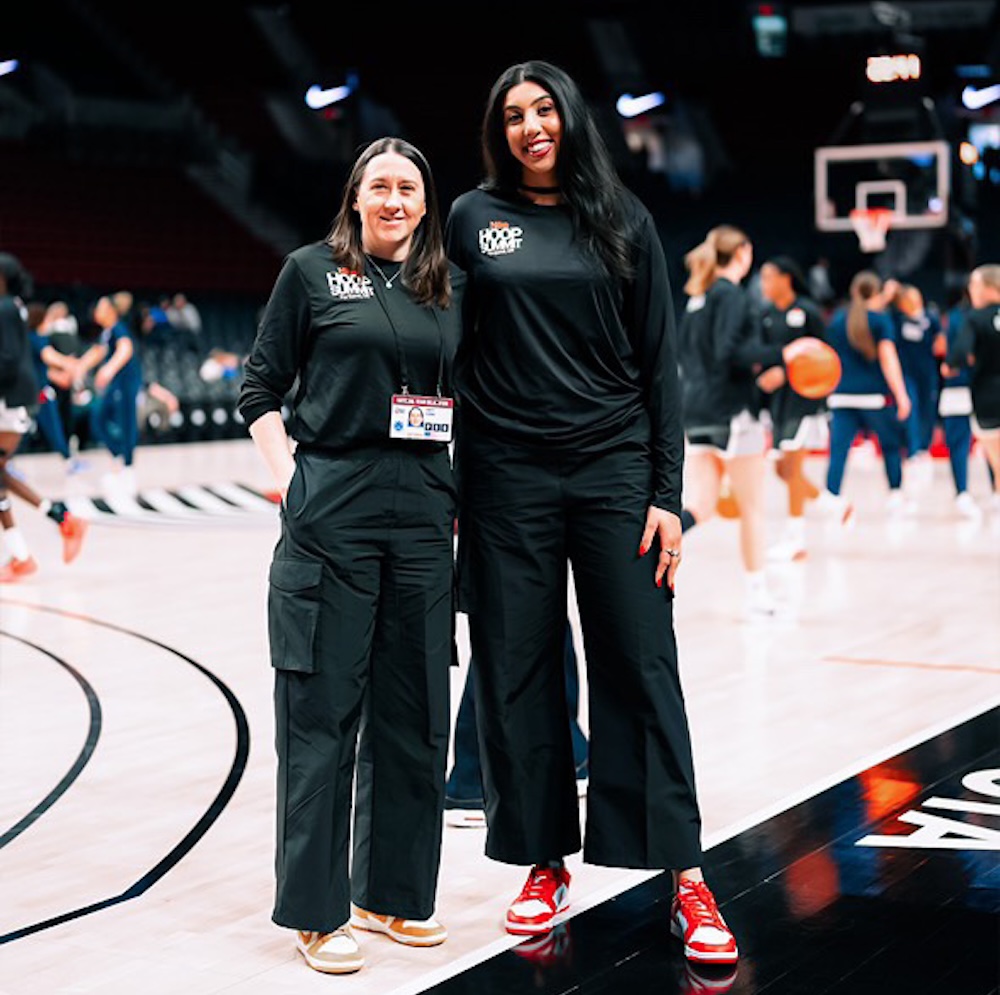
“It’s really hard to simplify Carly and who she is, but her motto is about being the best at getting better, and I think she does that in everything,” said Dheensaw. “She balances being a people-first person while also having this exceptional tactical mind. Of all the things that I’ve done, working under and with Carly Clarke will be the best thing that I’ve ever done as a coach, and it cemented that I wanted to coach.”
Dheensaw then got her first in-game head coaching experience over the past two seasons at Brock where she led the Badgers to a combined 40-21 overall record, .
At each and every one of her coaching stops, the inquisitive Dheensaw left with insoluble relationships and a greater depth of understanding of all that must be brought into focus on a daily basis — on and off the court — in order to create and maintain what is the heartbeat of any successful program: a thriving team culture.
And through a veteran observer’s eyes, the most assuring part of Dheensaw’s DNA surely seems to be her realization that there aren’t any shortcuts on the road to being the kind of coach with the ability to summon leadership and inspiration from the most transparent and genuine of places.
WHY OUR MENTORS MATTER
Separate from the B.C. roots of her coaching tree are the ones Shae Dheensaw has sown outside of the province… the ones this recovering vagabond has nurtured each time the call has beckoned her to points afar, all in the name of attaining coaching excellence.
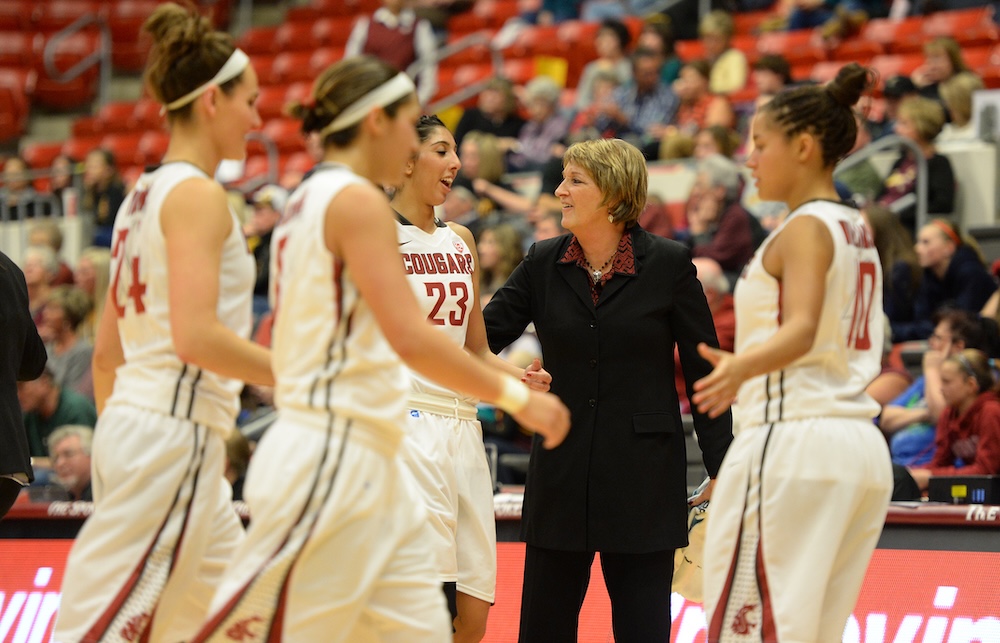
“I think it all started with June Daugherty who was my coach at Washington State,” Dheensaw says of perhaps the most influential women’s college basketball coach in the state’s history, one who first spent 11 years as the head coach at Washington then moved directly on to 11 more years as the head coach at Washington State.
“She kind of gave me the shoulder tap that a lot of young females need,” Dheensaw says with reverence. “She just kind of guided me. I got injured in my senior year at a time when all I knew how to identify was as an athlete. When you’re going through it, it’s like your whole day-to-day existence is just washed away completely. June grabbed me, and without saying it directly was just like ‘This is your path… you’re built for it. You see the game in a different way. You play it in a different way.’”
Sadly, Daugherty passed away from heart complications in 2021 a week shy of her 65th birthday.
Yet another one of those kismet-like moments of personal affirmation came this past spring during Dheensaw’s application process for the Simon Fraser job.
Dheensaw interviewed for her position with SFU athletic director Breanne Watson who herself played for the Washington Huskies from 2003-04 through 2006-07 where she started 74 of her 117 career games.
Her head coach with the Huskies? Yes, June Daugherty.
“I had this really cool moment a few weeks ago… June Daugherty’s daughter sent me this really cool photo of June and I and she told me that she’s always loved it,” said Dheensaw. “Then, I got to tell her that I had a chance to involve June in my SFU interview process.”
For Dheensaw, the chance to be able to honour her late head coach as the genesis of her own coaching origin story was beyond special to her.
She’d of course have related it to anyone who was interviewing her because to her it was truly transformative. But to relate all of that to someone who had also played for Daugherty?
“I was able to explain (to Daugherty’s daughter) that June is the reason I wanted to coach, and then to be able to narrate all of that to Breanne, who also knows her? It was so surreal. It was like all of my worlds were colliding and it was just another point as to why SFU is home for me.”

WHY SHE’S “BUILT FOR THIS” CHALLENGE
Shae Dheensaw is just the third Simon Fraser women’s head basketball coach in the last 39 years.
“That’s an incredible element and I think it says a lot about SFU as a place to play, a place to go,” Dheensaw begins of the university, and the excellence both Allison McNeill and Bruce Langford brought to the West Gym over their combined 38-year succession. “You don’t just come and go at SFU, you build a life here, like when you watched Bruce… his daughter won a championship here with him and so this is genuinely family,” adds Dheensaw. “And when I was in high school I got to be coached by (Bruce’s younger brother) Paul Langford on the B.C. team. So I got the Langford family.”
Not only that, the recent actions of Dheensaw’s two most recents coaching predecessors have so selflessly insured that Red Leafs’ women’s basketball — despite now affiliations in the NAIA, NCAA and CIS/U Sports — will continue to build its legacy in whatever athletic union it happens to lay its hat to call home.
“Allison has been a huge mentor for me, even back to when I was being recruited,” says Dheensaw. “Both Bruce and Allison have been nothing but supportive and that’s been incredible and helpful. You know, neither of them really needed to connect or to support but they both are doing it, and it shows the level of care that they will always have for this program. And it actually highlights what they were in it for the whole time, which wasn’t the championships but the weddings you get invited to decades later.”
And just how good a job did her two predecessors do?
For 13 season from 1988-89 through 2000-01, McNeill’s teams went 363-79 for a winning percentage of .821.
For 25 seasons from 2001-02 through 2025-26, Langford’s teams went 524-224 for a .701 winning percentage.
When you add them both together it’s a rather astonishing 887-303 mark, good for a winning percentage of 74.5 per cent.
Now, with its season-opening exhibition game against future Canada West league rival Fraser Valley Cascades slated for October. 23 at the West Gym (5:30 p.m., men vs. UFV 7 p.m.), Dheensaw will begin to put her game-day stamp on not only the 2026-27 team, but future ones as well as she navigates — as McNeill and Langford both also did during their tenures — a unique transition from the NCAA this season to a U SPORTS return in 2027-28.
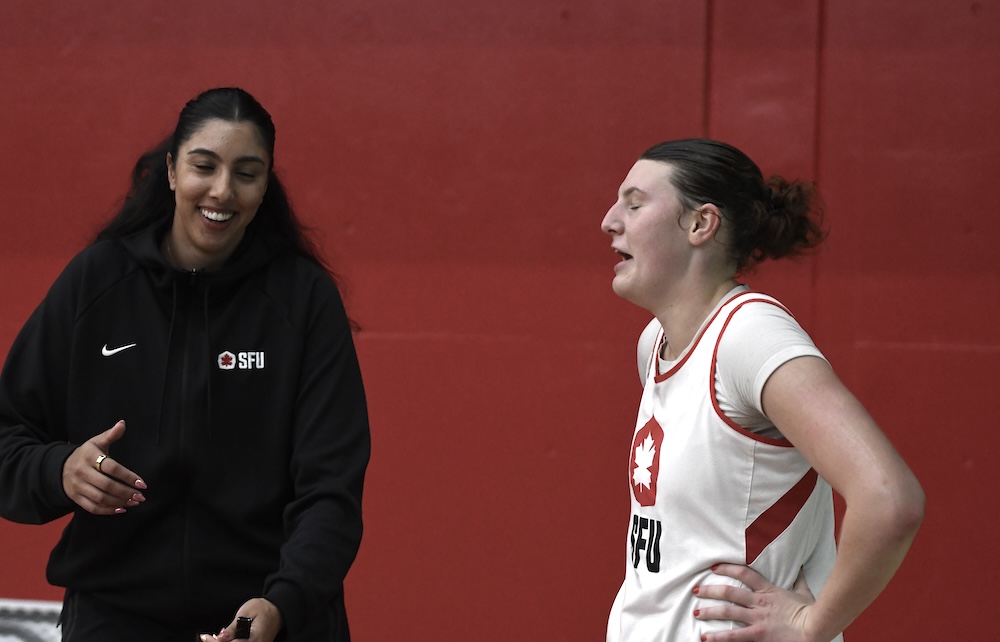
Yet true to her core beliefs, Dheensaw embraces her new program’s history, naturally channeling that energy as a positive force.
“When we call recruits we get to tell them that you’re following Teresa Gabriele, you’re behind Nayo (Raincock-Ekunwe), Erin Chambers, Dani Langford… these names are crazy, and so I think when SFU came knocking, and because of the history I’ve inherited, it’s super exciting for the future to tell the players that not only do we think you’re going to be great, you’re also walking into this incredible group of women and you will be a part of them. The legacy they left, you’ll get to build on.”
That’s Dheensaw’s message to both current and future SFU women’s players, but it also jibes with her own mission as she takes the torch from Langford as he did in 2001 from McNeill.
“SFU has a proud history of outstanding coaching in women’s basketball,” said Red Leafs’ athletic director Watson. “We are confident that Shae will carry that tradition forward, building on the foundation Allison and Bruce established on Burnaby Mountain.”
One thing that seems certain is that those full-circle moments will just keep coming for Shae Dheensaw because without her saying it, you can tell she gains palpable energy from an appreciation of the past..
“I think about watching that video about Allison’s first team,” she continues in reflection of the becoming the program’s first new head coach in a quarter of a century.
“It is one of those reminders of our history that I keep on getting, and when I talk to Allison and I talk to Bruce,” she says, “I don’t take it as stress. Pressure is a privilege, and we have the privilege of pressure at SFU.”
What could be better?
If you’re reading this story or viewing these photos on any website other than one belonging to a university athletic department, it has been taken without appropriate permission. In these challenging times, true journalism will survive only through your dedicated support and loyalty. VarsityLetters.ca and all of its exclusive content has been created to serve B.C.’s high school and university sports community with hard work, integrity and respect. Feel free to drop us a line any time at howardtsumura@gmail.com.
